There’s a piece of advice that floats around every SEO blog, every YouTube tutorial, and every digital marketing course:
“Keep your content fresh.”
I’ve heard it hundreds of times. I nodded along, made a mental note, and then went back to doing what most content creators do — publishing new articles and moving on.
It wasn’t until 2026 that I truly understood what “keeping content fresh” actually means — not as a best practice tip, but as something I felt directly in my traffic numbers, my rankings, and my overall site performance.
This post is my honest account of what happened, what I did about it, and what I learned in the process.
The Setup: Articles That Were Working Well
By mid-2025, I had built a decent content library on my website. Several articles were performing consistently — ranking on the first or second page of Google, pulling in organic traffic, and generating clicks from search results.
I wasn’t doing anything extraordinary. I had focused on on-page SEO, proper keyword targeting, and making sure the content was well-structured and readable. I had followed the principles in my on-page SEO checklist, and things were working.
Life was good, at least from an SEO perspective.
Then 2026 arrived.
The First Sign Something Was Wrong
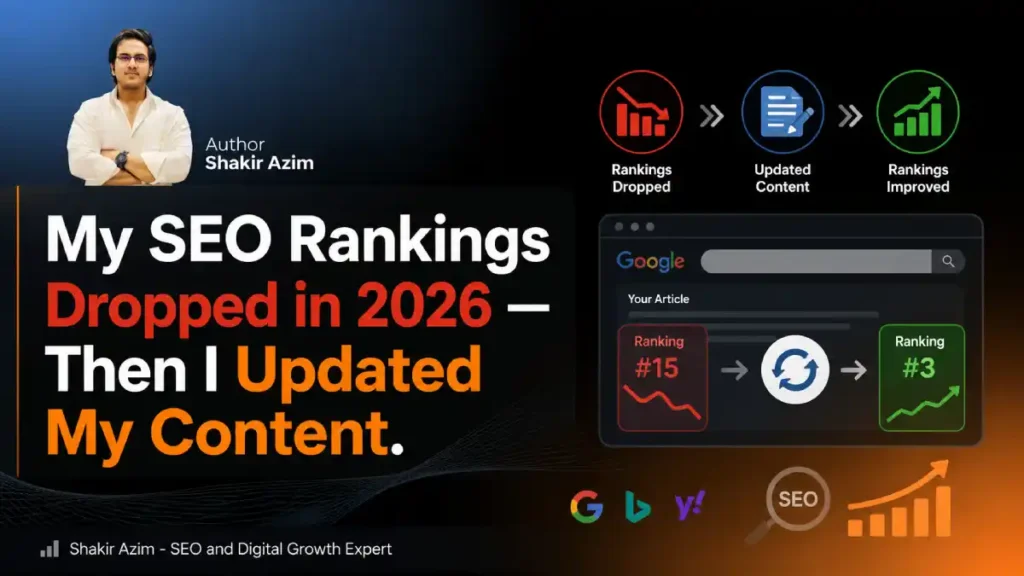
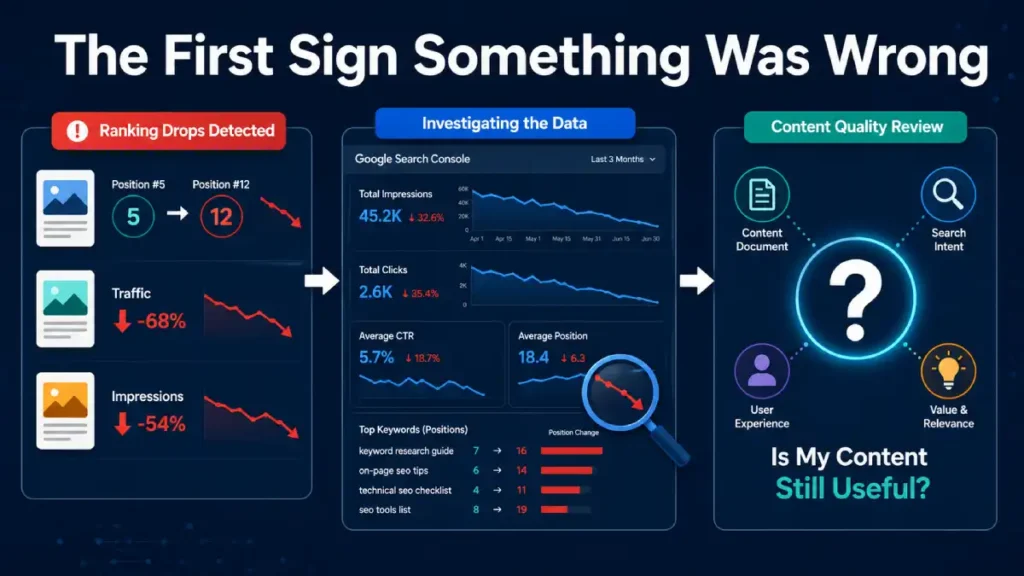
It started subtly. A few articles that had been ranking dropped from position 5 to position 12. One post that was regularly bringing in daily traffic went almost silent. Another that I considered a cornerstone piece seemed to disappear from search results altogether.
At first, I convinced myself it was a temporary Google update. Rankings fluctuate — that’s normal. Every SEO professional will tell you that.
But weeks passed, and the numbers didn’t recover.
I pulled out Google Search Console and started reviewing what was happening at the page level. Impressions were down. Click-through rates had dropped. Some URLs had lost a significant chunk of their keyword positions.
That’s when I stopped blaming algorithm updates and started asking a harder question:
Was my content still genuinely useful?
The Real Problem: Outdated Content in a Fast-Moving Field
When I actually sat down and re-read some of my articles — properly, as if I were a new reader — the issues became obvious.
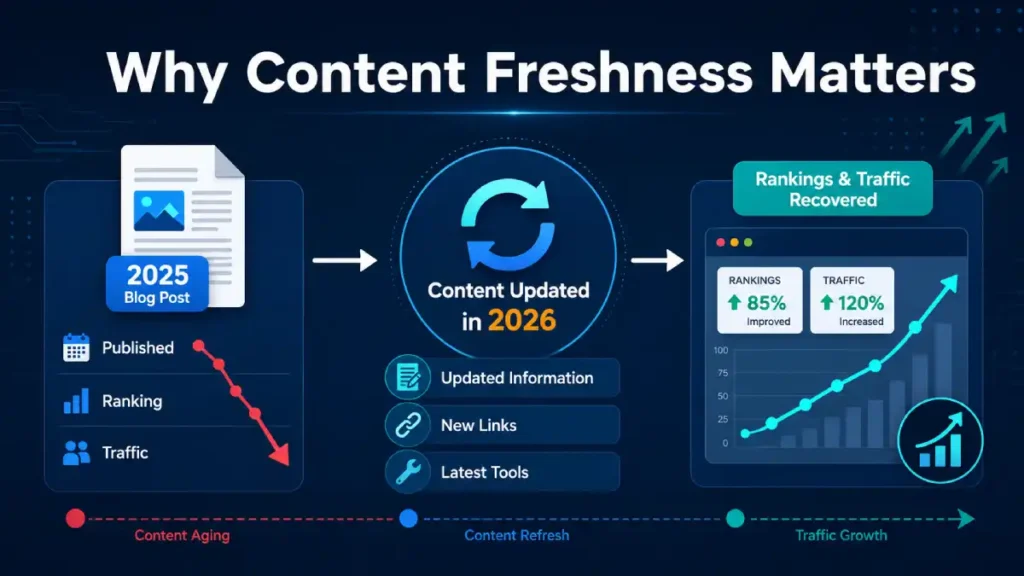
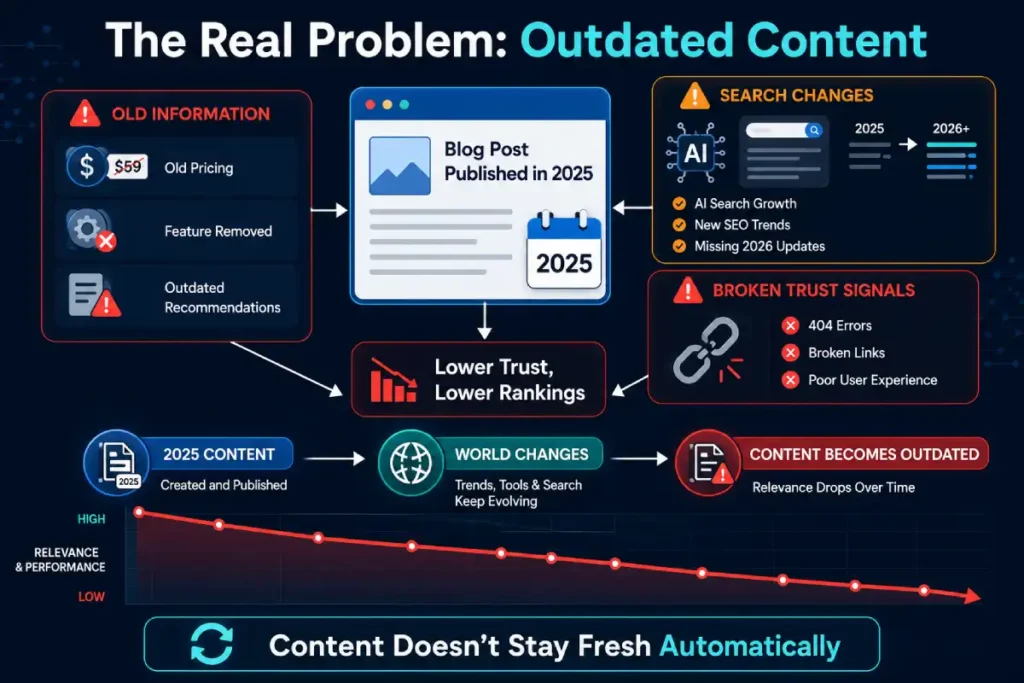
One article about SEO tools recommended products based on 2025 pricing. Some of those tools had changed their plans. One had even shut down a feature I had highlighted. A reader landing on that page in 2026 would find information that no longer applied to them.
Another post discussed content strategy techniques that were solid in 2025 but had been partially overtaken by AI-driven search changes. The recommendations weren’t wrong — they were just incomplete for 2026.
A third article had two outbound links that were returning 404 errors. The pages had either moved or been removed. From a trust and quality standpoint, that was a red flag for both users and search engines.
The deeper I looked, the clearer the pattern became.
My content hadn’t degraded because I had done something wrong. It had degraded because the world had moved forward and my pages hadn’t moved with it.
This is one of the most common SEO mistakes to avoid — treating content like a one-time task rather than an ongoing asset.
Why Google Cares About Content Freshness
Before I get into what I changed, it’s worth understanding why this happens at all.
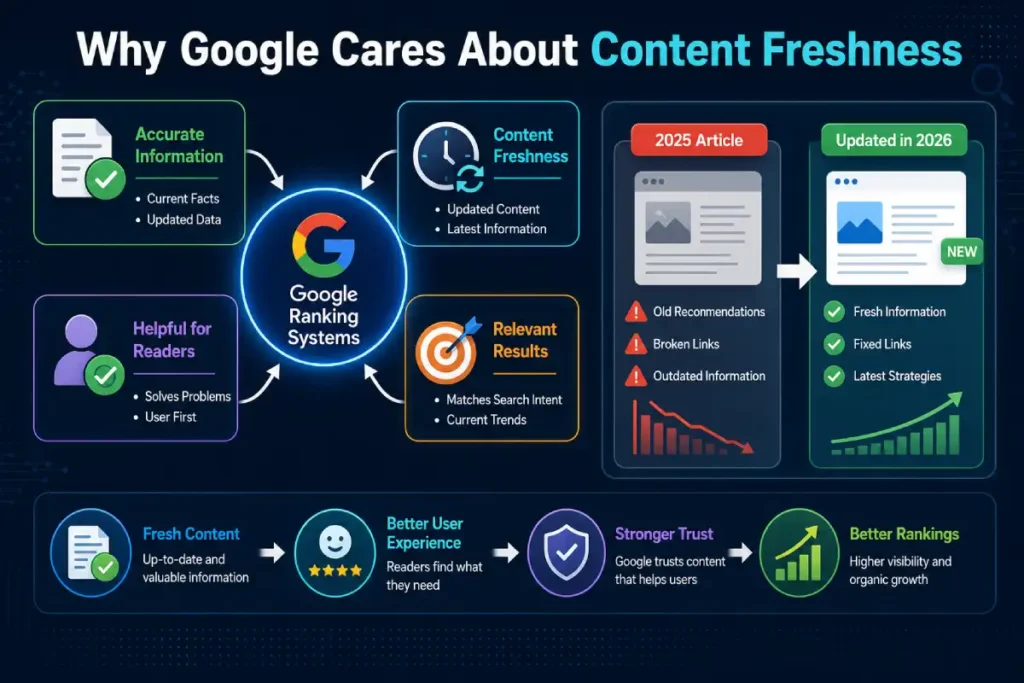
Google’s ranking systems are designed to surface the most helpful, accurate, and relevant content for each search query. This is clearly stated in Google’s own documentation on how their ranking systems work. One of the factors Google evaluates is freshness — not just the publication date, but whether the content actually reflects current information.
This doesn’t mean you need to update every article every month. But in fast-moving industries — like SEO, digital marketing, AI, and WordPress development — information can become outdated within months, not years.
Google is also getting increasingly sophisticated at detecting whether content is genuinely useful or just technically optimized. Their helpful content guidance makes it clear that pages should be written for people first, with accurate and up-to-date information that actually helps the reader.
If your 2025 article is sitting on the same page in 2026 without any updates, and users are clicking on it only to find outdated recommendations and broken links, that’s a signal — both to users and to Google — that the content isn’t delivering value anymore.
What I Actually Changed (Step by Step)
I didn’t go into panic mode and rewrite everything from scratch. That would have been unnecessary and risky — rewriting content entirely can sometimes harm what’s already working.
Instead, I took a more surgical approach. Here’s exactly what I did for each article.
1. Updated Year References and Context
Anywhere I had written “in 2025” or “this year (2025),” I reviewed whether the context still applied. Where it did, I updated the reference to 2026. Where the point was time-sensitive, I rewrote the section to reflect the current situation.
This wasn’t about keyword stuffing “2026” into the article. It was about making sure the framing felt current to someone reading it today.
2. Refreshed Tool Recommendations
Any article that mentioned specific tools — SEO platforms, content tools, WordPress plugins — went through a review. I checked current pricing pages. I verified that features I had described still existed. I added newer tools that had become relevant in 2026 and removed recommendations for tools that had become outdated or too expensive for their value.
My go-to reference for this was my own best SEO tools guide, which I had also updated separately.
3. Fixed and Updated All Links
Every internal and external link in each article was checked. Broken outbound links were either removed or replaced with updated sources. I strengthened internal linking by connecting articles to newer posts I had published in late 2025 and early 2026. A strong internal linking strategy is not just about navigation — it signals to Google which pages are related and important, and it keeps users moving deeper into your site.
4. Improved Thin Sections
Some articles had sections that were only 2–3 sentences long. I expanded these where the topic deserved more depth. Not padding — just genuine extra information that made the section more useful for the reader.
5. Added New Insights Relevant to 2026
The biggest change in SEO between 2025 and 2026 has been the rise of AI-driven search. Features like AI Overviews in Google and the shift toward generative results have changed how content gets found and consumed. Where relevant, I added context around this. I also linked to my guides on AI search optimization and generative engine optimization to help readers go deeper.
6. Removed Outdated Information
This is the step most people skip. Removing content feels counterproductive — shouldn’t more content be better? But irrelevant information reduces the quality signal of a page. I cut anything that no longer applied, didn’t add value, or could mislead a reader in 2026.
7. Reviewed and Tightened On-Page SEO
For each updated article, I also ran through the basics — meta title, meta description, heading structure, image alt text, and page speed. I use my own on-page SEO checklist as a reference every time I publish or update a page. It’s a habit that takes 10–15 minutes but makes a noticeable difference.
The Results: What Actually Happened After Updating
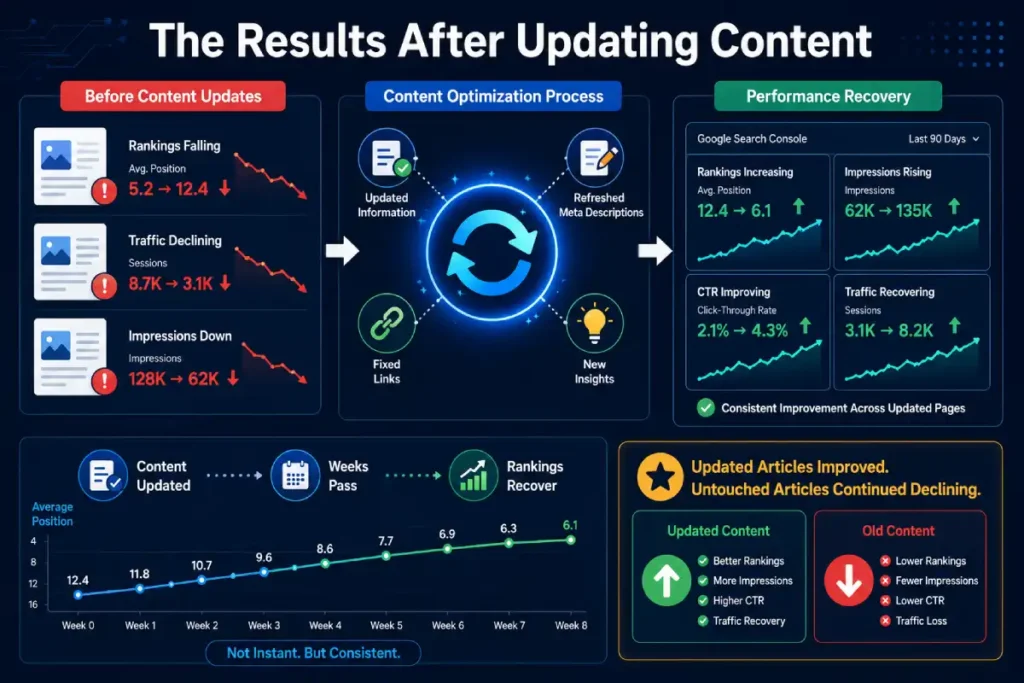
Over the weeks following the updates, I tracked performance through Google Search Console and noticed gradual but consistent improvement.
- Several articles that had dropped from positions 5–10 began climbing back up.
- Impressions increased across updated pages.
- Click-through rates improved, likely because the meta descriptions were refreshed and more relevant.
- One article that had lost nearly all traffic within a two-month window recovered to nearly its previous performance levels.
Was it instant? No.
Was it dramatic overnight? No.
But the trend was clear and consistent.
The updated articles were recovering. The articles I hadn’t touched yet were still declining.
That was enough evidence for me to keep going.
The Content Mistake I Was Making (And Most People Still Make)
Here’s the mindset shift that this experience forced:
Most content creators think about content creation in terms of output. How many posts can I publish this month? How many words? How many keywords am I targeting?
But that framing misses something important.
A blog isn’t just a library of articles. It’s a living resource. And living resources need maintenance.
Think about software. When developers release an app, they don’t just launch version 1 and disappear. They release updates, fix bugs, improve performance, and add new features. The same URL, the same app — but constantly evolving.
That’s exactly how I now think about content.
You publish Version 1. Then you improve it based on what users actually need. Then you update it again when the industry changes. The URL stays the same, the authority builds on that URL over time, and the content gets better with each iteration.
This is also why topic clusters for SEO matter so much. When your articles are connected around core topics and each one is kept current, your site builds authority that is resilient to algorithm changes — not dependent on a single article doing all the work.
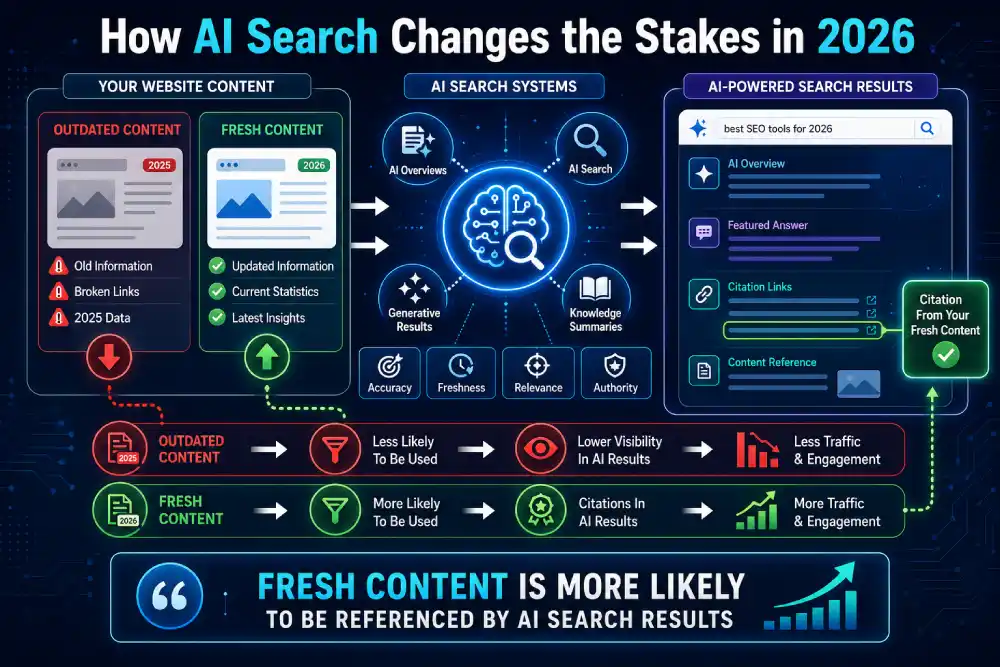
How AI Search Changes the Stakes in 2026
One thing that makes content freshness even more critical in 2026 is the rise of AI-generated search results.
Google’s AI Overviews now pull directly from web content to generate summaries for users. If your article contains outdated information, there’s a chance Google might not pull from it — or worse, might pull from it and display inaccurate information under your brand’s name.
Content that is accurate, well-structured, and up-to-date is far more likely to be cited in AI-generated responses. According to Moz’s research on AI search and content quality, pages with strong topical relevance and current information are significantly more likely to appear in AI-driven features.
This is something I’ve explored in depth in my guide on generative search optimization, which covers how to structure content so it performs well not just in traditional rankings but in AI-powered search results too.
How I Now Structure My Content Maintenance Plan
After this experience, I created a simple process for content maintenance that I follow on a regular basis.
Quarterly Content AuditEvery three months, I go through my top-performing and previously top-performing articles using Google Search Console data. I look at:
- Which pages have dropped more than 20% in impressions
- Which pages have declining CTR despite decent impressions
- Which pages have thin content or outdated references
Monthly Link CheckI do a quick sweep of outbound links in older articles to catch any that have broken. Broken links are both a user experience problem and a technical SEO issue.
Update Before You Publish NewBefore writing a new blog post, I now ask: do I already have an article on this topic that just needs to be updated? If yes, I update instead of publish. This avoids content cannibalization and strengthens existing authority rather than diluting it.
Strengthen Internal Links on Every UpdateEvery time I update an article, I also look for opportunities to add internal links to newer posts I’ve written since the original publication. This helps newer content get discovered faster and builds the overall architecture of the site. I’ve written a detailed breakdown of this in my internal linking strategy guide.
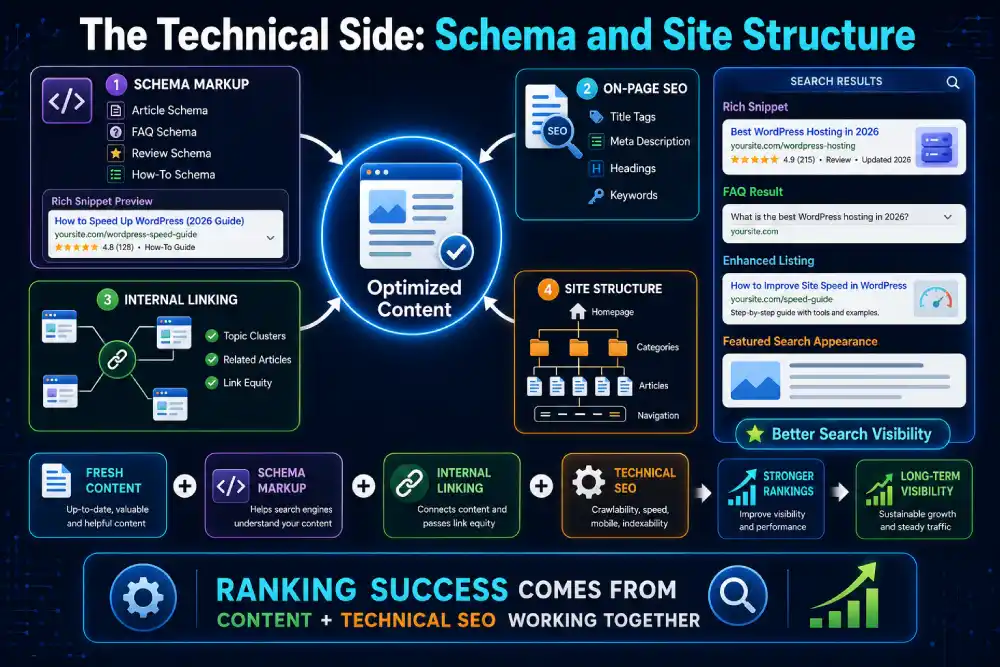
The Technical Side: Schema and Site Structure
One thing I noticed while updating articles was that several didn’t have proper schema markup in place. Schema helps search engines understand what your content is about — whether it’s a how-to, a review, an FAQ, or a standard article.
Adding or updating schema on refreshed content can improve how your pages appear in search results, including with rich snippets. I’ve covered this in detail in my schema markup essentials guide.
The combination of fresh content, strong on-page SEO, proper schema, and a well-connected internal structure is what gives an article the best possible chance of ranking and staying ranked.
For a complete framework that brings all of this together, my WordPress SEO optimization guide covers the full technical and content-level approach from one place.
What This Means for Your Content Strategy
If you’re a blogger, freelancer, or website owner reading this, here’s the practical takeaway:
You don’t always need to create more content. Sometimes you need to make your existing content better.
Before you write your next blog post, spend 30 minutes reviewing your five most important articles. Ask these questions:
- Is every tool I mention still the right recommendation?
- Are all my links working?
- Does the introduction still match what users are searching for in 2026?
- Is there a newer, better way to explain the core concept?
- Have I updated meta titles and descriptions to reflect current language?
If the answer to any of these is no, updating that article is likely a better investment of your time than publishing something brand new.
I’ve talked about this kind of thinking in my content strategy for creators guide, which looks at how to build a long-term content plan that balances publishing new content with maintaining what already exists.
Final Thoughts
This is not a scientific case study with statistically significant data. It’s one website owner’s honest experience.
But the pattern was clear enough that it fundamentally changed how I manage content.
Fresh content doesn’t mean new content. It means relevant content.
In fast-moving industries like SEO, digital marketing, AI tools, and WordPress development, relevance has a shorter shelf life than most people assume. What was accurate and helpful in 2025 may be incomplete, outdated, or even misleading in 2026.
The good news is that updating existing content is almost always faster, easier, and less risky than starting from scratch. You’re building on authority that already exists. You’re improving something that has already been indexed and ranked. You’re giving Google a reason to recrawl and reevaluate your page with better signals.
If your traffic has dropped and you haven’t looked at your existing content recently, that’s where I’d start.
Not with a new article. With an honest review of what you already have.