I’ve been doing SEO for a long time. It’s what I do for a living: finding keywords, writing content, and watching websites go from page three to page one. But I also operate a service business, and I kept asking myself, “Why do I have to wait six months for results?” What if I could test some keywords more quickly?
So I ran a modest Google Ads campaign for myself last year. Not much, just a small daily budget to advertise my SEO services. I didn’t want to spend thousands. It was to see for myself what small business owners go through when they run ads.
I wanted to find out:
- How quickly does my budget really go up in smoke?
- What kinds of clicks am I really getting?
- Are these clicks turning into customers, or am I just wasting money on people who aren’t serious?
- How does this stack up against what my SEO work gets me?
What I learned from this article is not theory. Not guesses. This is data from running advertising in the real world, real prices, genuine problems regarding lead quality, and honest opinions about which tactic really works in different situations.
Understanding Google Ads in Practice
Google Ads is based on a simple idea: you bid on keywords, and when someone searches for those keywords, your ad shows up at the top of the search results. You only pay when someone clicks on your ad.
This is how it really works:
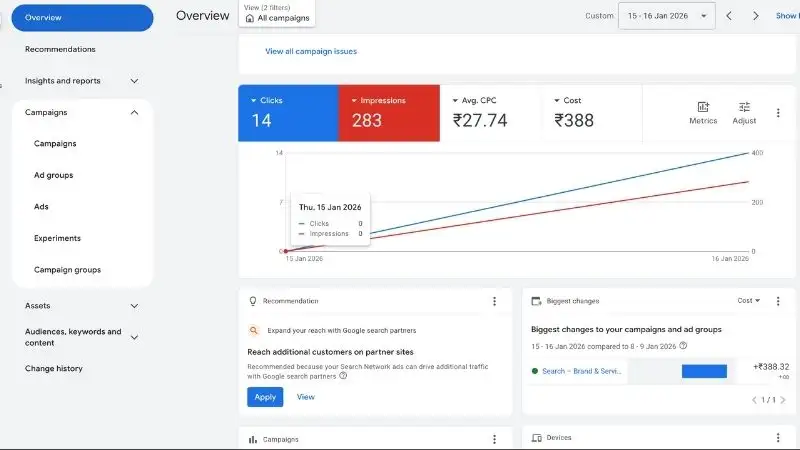
You make a daily budget. I set mine to ₹500 a day. That means Google will pay for my adverts about ₹500 every day. That’s around ₹15,000 for a month of 30 days.
If you want to see how Google actually handles your average daily budget and monthly spend, you can read Google’s own explanation in their official help article on average daily budgets.
You pick the keywords. I want my ad to come up for searches like “SEO services near me,” “affordable SEO packages,” and “hire SEO specialist Patna.” These are exactly the searches I want to show up for.
Your cost per click (CPC) is figured up by Google. This is when things start to get interesting. Depending on the keyword and the level of competition, my CPC ranged from ₹25 to ₹50 per click. For terms that were more competitive, like “SEO services,” I was paying closer to ₹40–₹50. I paid less for lengthier, more detailed phrases—sometimes ₹25–₹30.
Your budget goes up in flames quickly. This was the true shocker. If my average CPC was ₹35 and I got 15 clicks a day, it would be ₹525, which is basically all the clicks I could afford in a day. And that’s before anything changed.
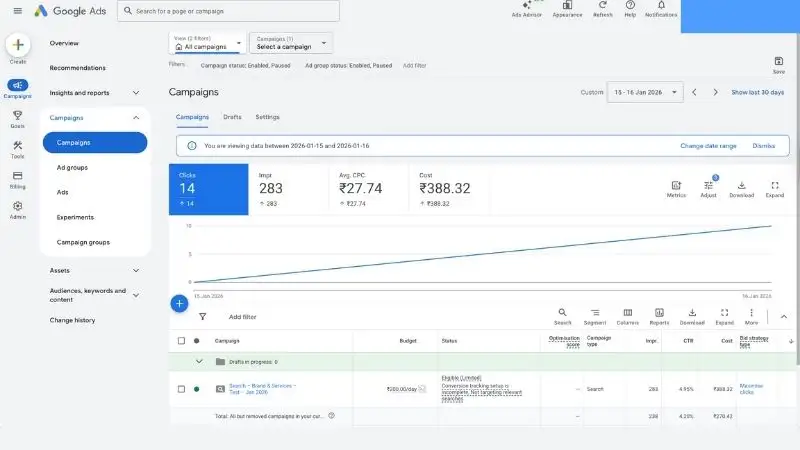
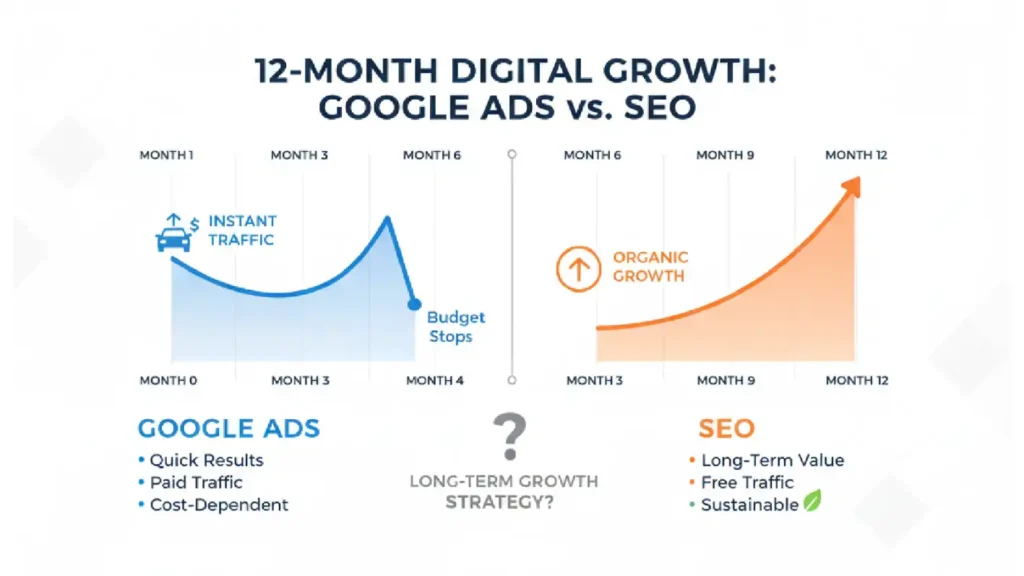
The most important thing to know is that the clicks stop as soon as you stop spending. If you halt your campaign, your advertising will only show for one day. The next day, nothing will show. You’re not building visibility; you’re renting it.
What SEO Looks Like in the Real World
SEO is not the same as advertisements. It’s slow, but it builds up.
I make articles for SEO. I optimize a service page. I create a structure for internal linking to other pages on the site. Other websites give me backlinks. All of this tells Google that my site is relevant and trustworthy for a certain term.
Then I wait.
In three to six months, my website starts to show up for those keywords. I don’t have to pay for each click that brings in traffic. It just… keeps coming. What about six months later? It builds up. New pages rank. Search results start to show keywords that are related. The traffic builds up on its own.
The fundamental difference: With Google Ads, I’m paying for every single click. With SEO, I only have to pay once (or every month as an investment), and the traffic stays flowing for years.
In real life, this means:
- Google Ads: Here today, gone tomorrow. A lot of control, instant visibility, and no residual value.
- SEO: Slow to start, but builds equity. You’re creating digital assets like pages, content, and authority that keep working.
Cost Comparison: Ads vs SEO
Let me show you how the numbers really work.
Monthly Google Ads
| Factor | Reality |
|---|---|
| Daily budget | ₹500–₹1,000 (testing small businesses) |
| Monthly expenses | ₹15,000–₹30,000 |
| Average CPC | ₹25–₹50 (service industry) |
| Clicks per month | 300–600 clicks (approximate) |
| Conversion rate | 3–5% typically |
| Expected leads | 10–30 leads per month |
| Cost per lead | ₹500–₹3,000 |
The hard truth is that if only 5% of clicks turn into leads and your CPC is ₹35, then your cost per lead is ₹700. That’s for a lead that might not turn into a sale. What if you stop the ads? No leads next month.
Monthly SEO
| Factor | Reality |
|---|---|
| Investment every month | ₹15,000–₹40,000 |
| Time frame for results | Initial rankings in 3–6 months |
| Clicks per month | 0 to 50+ throughout 6–12 months |
| Cost per click | ₹0 (organic) |
| Leads per month | Starts slowly and builds over time |
| Cost per lead (long-term) | ₹300–₹500 (spread over 12+ months) |
The good thing is that you only have to pay ₹15,000 a month for SEO work. After six months, you’ve invested ₹90,000. But now your pages are ranking, your content is getting clicks for free, and you’re generating momentum. Your cost per lead goes down dramatically by month 12 because organic clicks don’t cost anything.
Most crucially, after a year, you may cut back on or even stop spending money on SEO and still get traffic. Do ads do that? No way.
If you want to strengthen your SEO foundation further, understanding WordPress SEO optimization and implementing proper schema markup can accelerate your results timeline.
Click Quality & Search Intent: Not All Clicks Are Equal
I got clicks when I started my Google Ads campaign. Many of them. But not all of them had any meaning.
Here’s what made my advertising show up and which queries really mattered:
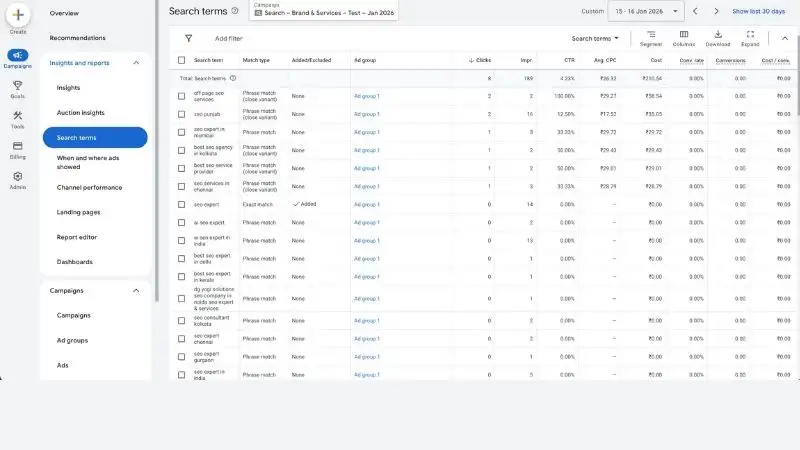
I wish I hadn’t used these broad match keywords:
- “Digital marketing services” → People who clicked were looking for help with Facebook ads, not SEO
- “Website optimization” → People looking for website builders, not SEO services
- “Affordable marketing” → A lot of people who want free consultations, not firms that are careful with their money
Some keywords that worked better were:
- “SEO services Patna” → Local intent, the proper place, and the correct audience
- “Increase organic traffic” → Shows you know your business and are more likely to buy
- “How to improve search rankings” → Research phase, but real business owners
The issue: Google showed my adverts for relevant searches when I used broad match terms. Some were useful. Many weren’t. It was pointless for me to pay ₹35 per click for someone looking for “free SEO tools.”
This is why the quality of leads is important. I could say “500 clicks, ₹17,500 spent,” but if only 50 of those clicks were from business owners looking to hire—not researchers or tool buyers—my real cost per qualified lead was ₹350, not ₹35.
A lot of firms make mistakes with Google Ads here. They care more about volume than intent. They get delighted about how many clicks they get, but then they wonder why no one buys.
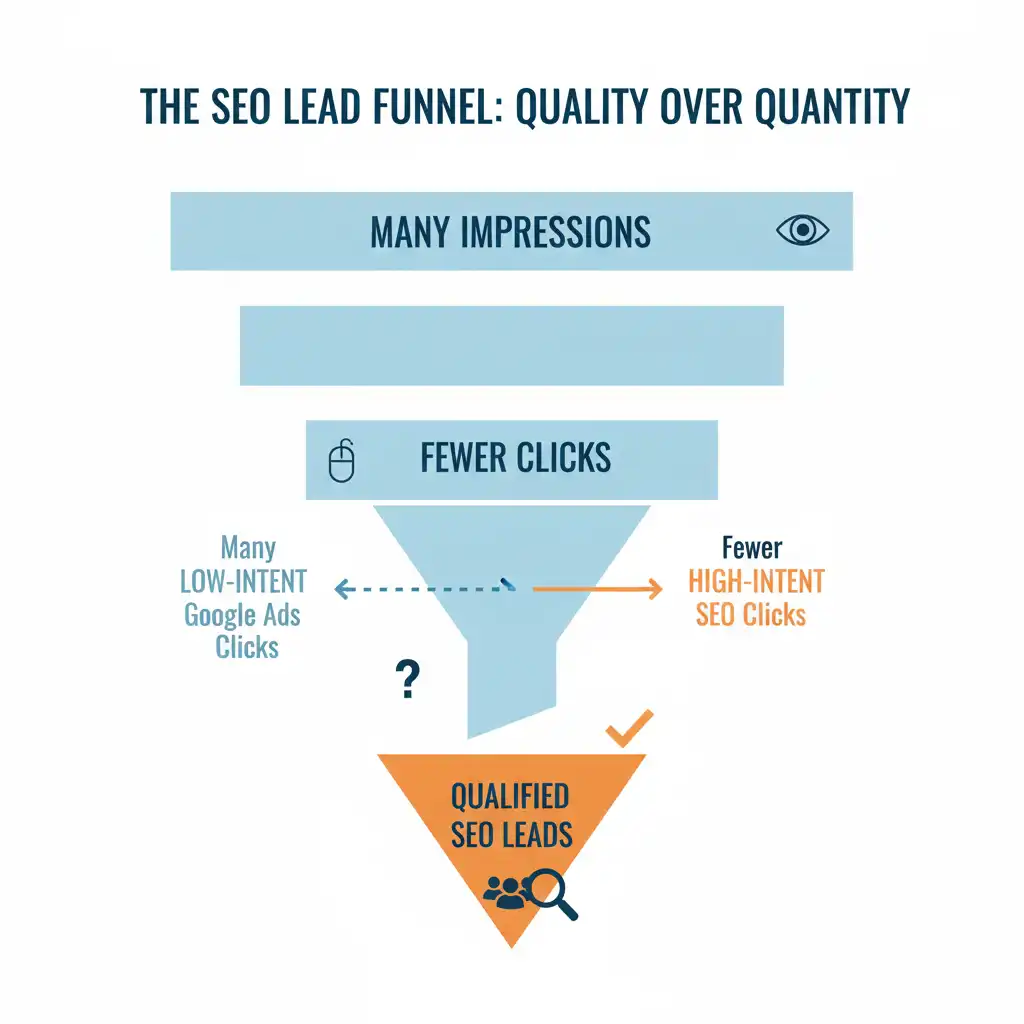
To avoid such costly mistakes, familiarize yourself with common SEO mistakes to avoid and apply similar discipline to your ad strategy.
Why Service Businesses Shouldn’t Only Use Google Ads
When I first set up my campaign, I didn’t have proper conversion tracking. I only had to keep track of form submissions and phone calls, and there was no way to connect Google Ads to my CRM. So Google’s algorithm didn’t truly know which clicks turned into paying customers.
If you’re new to this, it’s worth setting up conversion tracking the way Google recommends in their official conversion tracking guide before you spend serious money on ads.
This is what happened:
The Learning Phase Ruined My Budget
The “learning phase” is a part of Google Ads. When you first start a campaign or modify your bidding strategy, Google tests different bids, audiences, and keywords for a week or two to find out what works. At this point, your performance is all over the place.
I raised my daily spending by 30% one week, hoping to acquire more leads. Nope. That started a learning phase. For the next ten days, my CPC went up from ₹35 to more than ₹50. I spent more money and received fewer conversions. I basically wasted ₹3,000 learning something I could have read about online.
Not tracking conversions from the outset is a costly lesson.
Google finally figured out which clicks were important after I set up proper conversion tracking and connected it to my CRM. My costs went down. But I had already paid ₹5,000 to learn the lesson.
You Squander Money If Your Landing Pages Aren’t Optimized
At first, my advertising led to my homepage. General. Not related to the keyword. Someone who typed “affordable SEO packages” into a search engine came to my webpage, but since there was nothing about affordability, they left. Cost me ₹40 for nothing.
My conversion rate increased when I made separate landing pages for “local businesses,” “e-commerce stores,” and “SaaS companies.” Better conversion with the same traffic. This is where on-page SEO best practices directly support your ad strategy.
The Bigger Picture
In the big view, Google Ads takes discipline. You need:
- Tracking conversions correctly from the start
- Landing pages that are optimized to match the ad promise
- A clear idea of what a “good lead” really is
- Budget discipline to keep from spending too much while you learn
- Patience to let Google learn and self-control not to change things all the time
Without these, Google Ads turns into a costly lesson on how to market online. And most newbies don’t have this in place when they start.
Where SEO Wins Long-Term
I went back to SEO after three months of running advertising. I wrote in-depth guides, became an expert on certain topics, and got backlinks from industry magazines. It took longer. Boring, even.
But this is what happened:
After six months: I was ranking for more than 15 keywords. Getting 50–60 clicks from search engines every month.
After a year: 40 or more keywords ranked. More than 200 clicks from real people every month. What is the cost per lead? When spread out across the year, it comes down to ₹200.
Eighteen months later: More than 80 keywords. More than 400 clicks from search engines every month. This material builds up.
And here’s the thing that Google Ads can’t do: this traffic doesn’t stop when I stop paying.
Some of the stuff I made in 2024 is still bringing in leads as of January 2026. There are no adverts. No budget for each day. Google gives me free clicks since my content is helpful and Google knows it.
SEO Also Builds Brand Trust
People trust organic search results more than advertisements. It is real, even though it’s in your head. People who see my website at the top of Google’s organic results believe, “This company must be legit.” What about paid ads? They know I paid to be there because they see the small “Ad” label.
SEO Supports Everything Else
Better SEO means your website loads faster, has better content, and makes it easier to understand what you’re offering. These things also boost your Google Ads. They are good for your email marketing. They are good for your reputation.
But SEO doesn’t help Google Ads in the same manner, and this is important. Getting to the top of the search results doesn’t make your ads cheaper or better. They are two different ecosystems.
To truly master SEO and understand how it compounds, explore strategies like topic clusters for SEO and content strategy for creators to build the topical authority that drives long-term organic growth.
The Smart Way to Use Google Ads + SEO Together
This is where it starts to work.
This is how I use both strategies now:
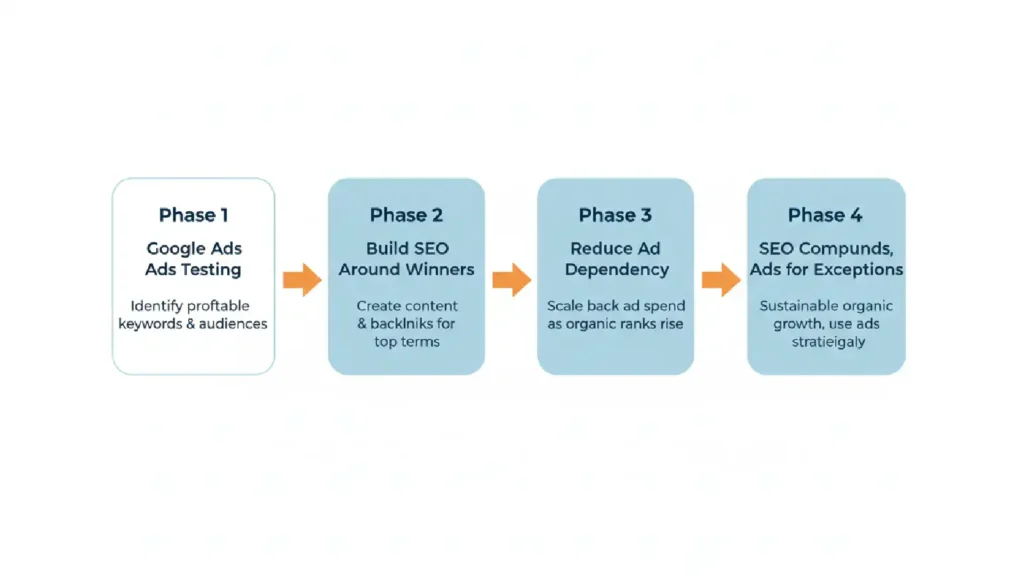
Phase 1: Google Ads for Quick Testing (Months 1–3)
I don’t wait for SEO when I want to try out a new service or join a new market. I run a tiny Google Ads campaign to answer quick questions:
- Which keywords really lead to sales?
- What messaging resonates?
- How much does it cost to get a lead in this market?
This will take two to four weeks. I pay ₹10,000–₹15,000 and get real information. After that, I stop the advertisements.
Phase 2: SEO to Build a Long-Term Presence (Months 3–12)
I know exactly which keywords are important because of the data from ads. I base my SEO on those winners. I write detailed tutorials, blog entries, and optimized service pages that focus on keywords that have already been shown to work in ads.
This costs between ₹20,000–₹30,000 a month, but I’m not guessing. I’m working on SEO with terms that have proven to convert. To optimize this phase, leverage best SEO tools that help you analyze competition and monitor your digital growth.
Phase 3: Cut Down on Ad Dependence (Months 6–12+)
My organic traffic goes up as my SEO rankings improve. I don’t need advertising for the terms that show high intent anymore. So I stop those commercials and move the money to:
- Still worth looking into lower-volume keywords
- Remarketing to those who came to my site but didn’t buy anything
- Testing out new markets where I don’t have SEO yet
Phase 4: SEO Compounds, and Ads Take Care of Exceptions (12+ Months)
After a year of SEO work, most of my leads come from organic sources. Ads become strategic:
- Campaigns that happen at certain times of the year
- Keywords that are hard for me to rank for organically (yet)
- New service debuts where I need immediate visibility
- Campaigns for remarketing
This is the best state. My SEO machine is generating consistent leads without daily spend. Ads are no longer required; they are now optional.
The Real Decision: Who Should Use What?
Let me be clear about who should do what.
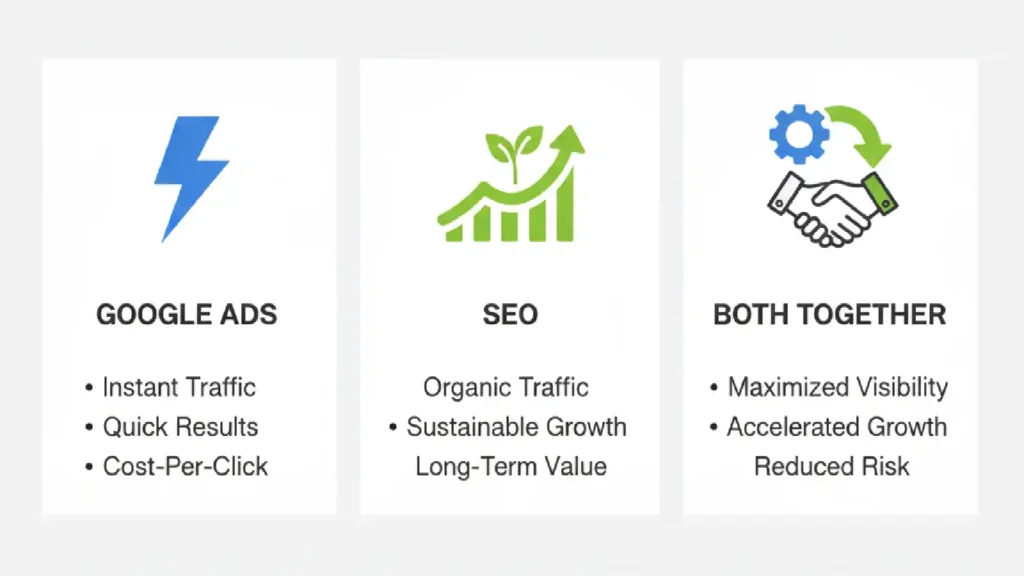
Use Google Ads If:
You need leads this month. You started a service, you have a sale, and now you’re in trouble. Google Ads sends right away. No waiting.
You are in a market with a lot of competition. If everyone is ranked for “digital marketing agency,” it will take more than a year for your organic campaign to work. Ads make you visible nowadays.
Before you spend money on SEO, you should test it. Do a modest marketing campaign, gather data, and then assess if SEO is worth it.
Your service area or target audience is small. You can target people quite precisely with ads. Perfect for local services.
You have money, but not enough time. You can engage a PPC manager to run ads and collect leads. It doesn’t require creating material, but it does require management.
Use SEO If:
You’re planning for more than a year from now. You want to own a keyword for good, not just rent it. Build the authority now, and then collect it later.
You want to lower the cost of getting new customers. Every dollar you spend on SEO today will save you money on ads later.
You’re fighting for terms that you can actually rank for. If you can go to #1 without paying, that’s better than paying to get to #1.
You want traffic that comes back. You want leads to come in six months from now without having to manage them every day.
You want to do more than simply generate leads; you want to develop a brand. SEO material makes you look like an expert. That makes people trust you.
Use Both If (Most Likely):
You want money now and stability in the long future. Use advertisements to make money while SEO works.
You run a service firm that is growing. Ads take care of the present, while SEO takes care of the future.
You want to be the leader in your market. Both paid and organic presence show who is in charge. People notice your name all over the place.
Your marketing spend is more than ₹30,000 a month. You can pay for both. Choose one if you only have ₹15,000.
Conclusion: My Honest Take
Google Ads is a strong tool. It’s quick. It can be counted on. But it’s also costly and stops working as soon as you stop paying.
SEO takes longer. It takes time. But it’s the only plan that builds on itself. It’s the only method to develop business assets that will last for years.
After running both, here’s what I’ve learned:
Choose SEO if you’re just starting out and don’t have a lot of money. It costs less than ads and creates equity. Yes, it is slower. But in a year, you’ll have a machine that makes leads for ₹200–₹300 each instead of ₹500–₹1,000.
If you have a budget and are already established, use both, but utilize them wisely. Ads for quick wins and testing. SEO for anything else.
If you’re in a market with a lot of competition, don’t only use ads. You’ll lose money. Use SEO as your base and advertisements as your fuel.
If you’re providing services, make sure you filter out low-quality leads. One lead from an ad with high intent is worth ten random clicks. Don’t base your campaigns on volume; base them on intent.
The question isn’t “Should I use Google Ads or SEO?” It’s “How do I use Google Ads to check what I’ll build with SEO and then grow with both?”
That’s the kind of thinking that turns marketing from a cost into an investment.
For those ready to dive deeper into optimization, explore emerging strategies like generative engine optimization (GEO) and AI-powered search optimization to stay ahead of the curve.
Frequently Asked Questions
Q: Is it worth it to use Google Ads for SEO services?
A: Not as your only plan. Try it out for two to three months to see whether there is demand for the keywords. Next, put money into SEO. Ads are the accelerant, not the fuel.
Q: What is best for small businesses?
A: SEO for people who want to think long-term. Ads for things you need right away. Ideally, use advertisements to test your market first, then transition to SEO.
Q: What is the real cost of Google Ads?
A: For service businesses in India, expect to pay ₹25–₹50 per click, which means that each qualified lead will cost between ₹500–₹3,000, depending on the conversion rate and targeting. Plan on spending ₹15,000–₹30,000 a month for meaningful testing.
Q: How long does it take for SEO to bring in leads?
A: For competitive keywords, the first results will come in 3–6 months. Significant volume by 12 months. Full potential after 18 months.
Q: Is it possible to do both on a tight budget?
A: If you only have ₹15,000 a month, go with SEO. Run ₹15,000 on each if you have more than ₹30,000. Split budgets rarely work optimally.
Q: What should I do first—ads or SEO?
A: Run a small ad campaign for two to four weeks and spend ₹10,000–₹15,000 to test the keywords. Then put money into SEO for those keywords that work. You will save time and money.
Ready to Make Smarter Marketing Decisions?
What the best strategy is depends on where you are in your business. Start by honestly answering these questions: How urgent is your lead’s need? When do you want results? How much money do you have? Then make your choice.
And if you’re doing SEO or running ads, make sure you’re measuring what really matters—conversions and cost per customer—not just clicks.
Your marketing budget deserves a strategy that builds value, not just rents visibility.